Akame ga Kill is often remembered for its shocking character deaths and intense action, but beneath its violent surface lies a carefully constructed dark fantasy narrative. The anime tells the story of a corrupt empire where power is concentrated in the hands of the cruel and incompetent, while ordinary citizens suffer silently. Rather than presenting a traditional hero’s journey, Akame ga Kill frames its story as a brutal struggle against an unjust system.
From the very first episodes, the anime establishes its core message: in a broken world, good intentions are not enough. Justice demands sacrifice, and even those who fight for the right cause will inevitably be stained by blood. This grim perspective defines the tone of the entire series and sets it apart from more idealistic action anime.
The Empire as a Symbol of Systemic Corruption
The Empire in Akame ga Kill is not evil because of a single villain, but because corruption has become systemic. Nobles abuse their power, officials exploit the poor, and violence is normalized as a tool of control. This portrayal gives the anime a strong political undertone that remains relevant even years after its release.
What makes the Empire especially disturbing is how ordinary its cruelty feels. Corruption is embedded in daily life, protected by tradition and authority. In this context, Night Raid’s actions are framed not as rebellion for glory, but as desperate resistance. The anime uses the Empire to explore how injustice thrives when power goes unchecked and accountability disappears.

Night Raid and the Moral Cost of Revolution
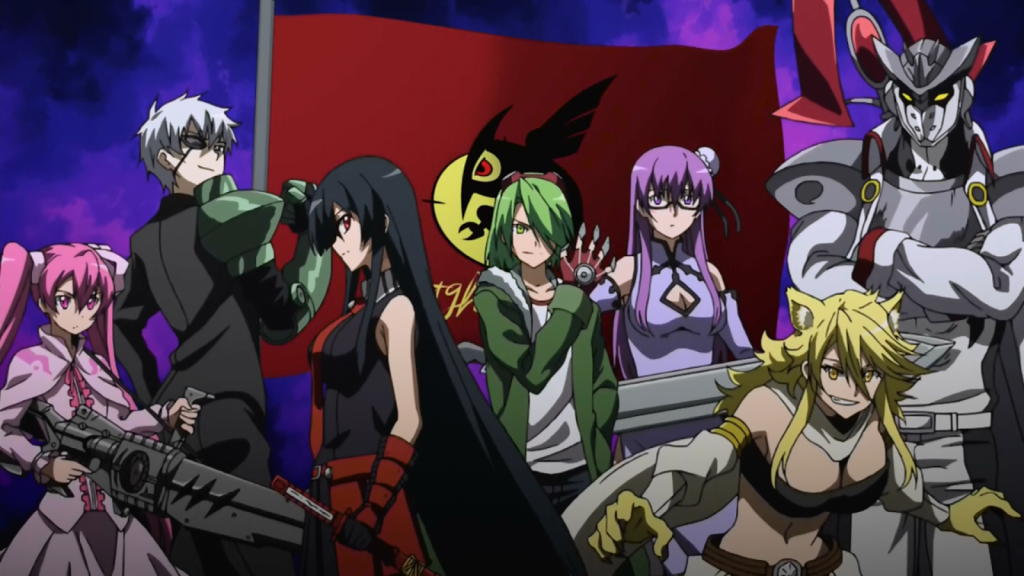
Night Raid is presented as a group of assassins fighting for the people, yet the anime never portrays them as pure heroes. Each member understands that their actions—no matter how justified—carry irreversible consequences. This moral ambiguity is central to Akame ga Kill’s storytelling.
The anime repeatedly asks whether killing for justice truly creates a better world. Night Raid succeeds in eliminating corrupt figures, but at the cost of their own humanity and lives. By refusing to romanticize revolution, the series emphasizes that systemic change is painful, slow, and often tragic. Victory, when it comes, feels hollow rather than triumphant.
Death as a Narrative Tool, Not Shock Value
One of the most controversial aspects of Akame ga Kill is its high number of character deaths. However, these deaths are not merely used for shock. Each loss serves a narrative purpose, reinforcing the anime’s central themes of impermanence and sacrifice.
By removing plot armor, the series forces viewers to confront the reality of violence. No matter how likable or important a character is, death can arrive suddenly and without fairness. This approach strengthens emotional engagement and prevents complacency, making every battle feel genuinely dangerous.
Power, Strength, and Twisted Ideologies
Through characters like Esdeath, the anime explores distorted philosophies surrounding power. Esdeath’s belief that the strong should dominate the weak is not portrayed as irrational madness, but as a worldview shaped by survival and war. This makes her ideology unsettlingly coherent, even when morally repugnant.
By contrasting Esdeath’s philosophy with Night Raid’s reluctant violence, Akame ga Kill highlights the complexity of strength. True power is not simply physical dominance, but the ability to endure guilt, loss, and responsibility. This thematic contrast adds depth to the anime’s conflicts and elevates them beyond simple good-versus-evil battles.
Innocence Lost and the Cost of Awareness
Tatsumi’s character arc represents the loss of innocence that defines Akame ga Kill. He enters the capital believing in honor and opportunity, only to discover exploitation and cruelty. His gradual awakening mirrors the viewer’s own realization that the anime’s world offers no easy solutions.
This theme of lost innocence extends beyond Tatsumi. Nearly every character carries emotional scars, reinforcing the idea that awareness itself is painful. To understand injustice is to be burdened by the responsibility to act, even when the outcome is uncertain or tragic.
Fate, Choice, and Inevitability
Another key theme in Akame ga Kill is the tension between fate and choice. Characters often feel trapped by circumstances beyond their control—social status, political systems, or past actions. Yet the anime emphasizes that choosing to resist, even in hopeless situations, still matters.
This perspective gives the series its tragic dignity. Characters do not fight because they expect to win, but because surrender would mean accepting a world built on suffering. In this sense, Akame ga Kill is less about changing the world and more about refusing to be complicit in its cruelty.
Final Thoughts
Akame ga Kill is far more than a violent action anime. At its core, it is a bleak yet thoughtful exploration of power, corruption, and the human cost of justice. Its willingness to confront uncomfortable truths—about revolution, morality, and sacrifice—gives it a lasting impact that continues to resonate with audiences.
In a genre often defined by escapism, Akame ga Kill stands out for its honesty. It does not promise happy endings or moral purity. Instead, it offers a story where meaning is found in resistance, even when the price is unbearably high. That depth is why the anime remains a powerful and unforgettable experience long after the final episode.
👉If you are a fan of Akame ga Kill, you can find and purchase merchandise inspired by the series at Official Akame ga Kill Merchandise:akamegakillmerch.com
